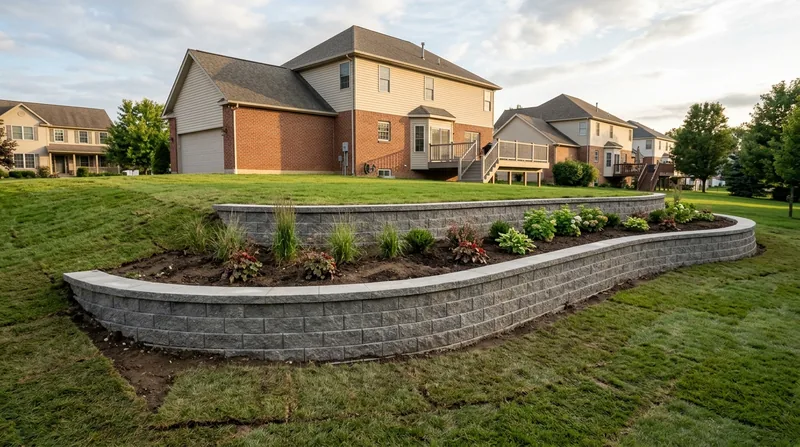




Block and segmental retaining walls in Buffalo are the modern answer to terracing steep lots, stabilizing driveways, and building garden walls that hold up through our punishing freeze-thaw cycles. From the lake-plain clay yards of Kenmore and North Buffalo to the rolling Southtowns terrain around Orchard Park and East Aurora, these engineered systems use interlocking concrete units stacked mortarless and tied back with geogrid, delivering strength without the brittle failure modes that plague older poured concrete and railroad tie walls. Buffalo's relentless winter, with deep frost and lake-effect snowmelt from storms like Snowvember 2014, puts real pressure on wall systems, and segmental block handles that punishment better than timber or single-pour concrete. Whether you are building a new terrace in Amherst, repairing a leaning wall in Clarence, or replacing a failed timber system in West Seneca, we install and repair these walls to code and to last.
Why Block and Segmental Retaining Walls Matter in Buffalo's Freeze-Thaw Climate
Buffalo sits at the edge of Lake Erie where the Niagara River begins, built on flat lake-plain clay and silt punctuated by the limestone ledge of the Onondaga Escarpment. That clay holds water, and water freezes. When it freezes, it expands, pushing outward on anything that tries to hold it back. Poured concrete walls crack and bow. Railroad tie walls rot and collapse. Segmental block systems, by contrast, are designed to flex slightly and shed water through drainage layers and geogrid reinforcement, absorbing the seasonal stress that breaks other walls.
- We install Allan Block, Versa-Lok, and Keystone systems that move with the soil rather than fighting it.
- Mortarless construction allows individual units to settle and shift without cracking the entire wall.
- Geogrid reinforcement ties each layer back into the soil, distributing load and resisting the outward push of frozen clay.
- Proper drainage behind the wall prevents water buildup that triggers freeze-thaw failure.
- These walls handle curves and terraces that poured concrete cannot match.
In Buffalo's climate, a properly built segmental block wall outlasts timber by decades and poured concrete by years, which is why more homeowners in Amherst, Clarence, and Orchard Park are choosing this system.
Local reality: Buffalo's heavy lake-plain clay and deep frost mean walls fail from outward pressure, not just erosion. Segmental block systems with proper drainage and geogrid handle this failure mode better than older concrete or timber walls.
For more on how walls fail in our climate and what to do about it, see our leaning and collapsed wall repair service.
How We Install Block and Segmental Retaining Walls in Buffalo
Installation of a segmental block wall is methodical and depends on site conditions, height, and load. We start by understanding the soil (clay, silt, or fill), the drainage situation, and whether the wall will support a surcharge like a driveway or patio. From there, we excavate the footing, set a gravel base, install the blocks in level courses, add geogrid every few layers, and backfill with drainage stone and fabric to keep water flowing away from the wall face.
- We excavate and prepare a solid gravel footing below the frost line to prevent settling.
- First course of blocks is set level and plumb, anchoring the entire structure.
- Geogrid is laid flat on each course and extends back into the retained soil.
- Subsequent courses are stacked with the block lip slightly back (batter), creating a stable angle.
- Drainage stone and geotextile fabric are installed behind the wall to manage water.
- Top course is capped and finished level for a clean appearance.
A typical garden wall in Buffalo takes one to two days; larger terraced systems in Orchard Park or Clarence may run longer depending on height and soil conditions.
Example: A 3-foot terraced wall in West Seneca holding back a walkout lot typically takes 2 to 3 days, costs from $25 per square foot, and requires a permit from the Town of West Seneca if the wall is above 4 feet from footing to grade.
Learn more about our retaining wall installation process.
Installation Methods and System Comparison
| System | Description | Best For |
|---|---|---|
| Allan Block | Large hollow units with integral lip for batter, mortarless, geogrid-reinforced. | Tall walls, terraces, and load-bearing applications in Buffalo and Amherst. |
| Versa-Lok | Modular solid or hollow blocks with shear key design, stacks without mortar. | Curved walls, medium heights, and tight spaces in Clarence and Kenmore. |
| Keystone | Gravity block with tapered face, no batter required, geogrid optional for low walls. | Garden walls, edging, and landscape features in Tonawanda and West Seneca. |
| Repair or Rebuild | Selective block replacement or full reconstruction of failed timber or concrete walls. | Replacing old railroad tie walls and leaning concrete walls across Buffalo and suburbs. |
Each system offers different aesthetics, load capacity, and installation speed. We choose the right one based on your wall height, soil type, and the look you want.
Block and Segmental Retaining Walls Cost in Buffalo: What to Expect
Block and segmental retaining walls cost in Buffalo starts at around $25 per square foot for a straightforward garden wall or low terrace, and can run higher depending on wall height, soil conditions, drainage complexity, and site access. A 3-foot wall running 20 feet long, for example, covers 60 square feet and would start around $1,500 before permits or site work. Taller walls, walls on steep grades, walls requiring engineered geogrid or special drainage, and walls in tight urban lots (like Allentown or the Elmwood Village) cost more per square foot because they demand more labor, materials, and expertise.
Factors that move cost up include:
- Wall height above 4 feet, which requires engineering and permits from your local building department.
- Poor or unstable soil that needs excavation, fill, or additional geogrid reinforcement.
- Difficult site access where equipment cannot reach easily.
- Existing trees, utilities, or structures that require careful work around them.
- Tiered or curved walls that take more time to lay out and install.
- High groundwater or drainage issues that require French drains or sump systems.
We always recommend getting two or three estimates to understand the scope and price range for your specific site. Every Buffalo lot is different, and a free on-site estimate is the only way to give you an honest number. For a full pricing overview and examples, see our pricing page.
Block and Segmental Retaining Walls Near Me: What Buffalo Homeowners Should Know Before Hiring
Hiring the right contractor for a retaining wall is about more than price. A wall is a structural element, and a poorly built one will fail, often within a few years. Look for a contractor who understands Buffalo's soil and climate, carries the right insurance, and can walk you through permits and local code requirements. Many Buffalo neighborhoods and towns require permits for walls above 4 feet measured from the footing, and some jurisdictions require engineered drawings for tall or tiered walls. Your contractor should know these rules and handle the paperwork, not leave it to you.
- Verify that your contractor is fully insured for retaining wall work in Buffalo and your specific town or city.
- Ask for references from recent jobs in your neighborhood (Amherst, Orchard Park, Kenmore, or wherever you are).
- Get written estimates from at least two contractors, including what is covered and what permits are needed.
- Confirm that your contractor will pull permits and coordinate with your local building department.
- Ask about HOA rules or deed restrictions if your property is in a covenant community.
- Request a timeline and explanation of how drainage and geogrid will be installed.
A good contractor will also inspect your site for utilities, existing trees, and soil conditions before giving you a price, because those details change the job significantly. If someone quotes you over the phone without visiting your lot, keep looking.
Ready to get started? Contact Buffalo Retaining Wall for a free estimate and a straightforward conversation about what your wall needs.
Block & Segmental Retaining Walls in Buffalo: Pricing Guide
| Service | Price | Details |
|---|---|---|
| Garden or landscape wall, up to 3 feet | Starting at $25/sq ft | Mortarless segmental block, geogrid, drainage, and finish. Cost varies with soil stability and site access. |
| Terrace or retaining wall, 3 to 5 feet, single run | Starting at $30/sq ft | Engineered geogrid, drainage stone, proper footing, and permit coordination. Assumes stable soil and accessible site. |
| Tiered or curved wall, or tall wall with surcharge | Starting at $35/sq ft | Requires engineered drawings, complex drainage, or multiple tiers. Soil testing and site conditions dictate final cost. |
| Wall replacement or repair of failed structure | On estimate | Removal of old wall, soil assessment, and new build. Site inspection required to determine labor and material scope. |
| Permits and engineering | Included | We handle coordination with your local building department. Engineered drawings billed separately if required by code. |
| Free estimate | No obligation | On-site visit, soil and site assessment, written quote. Response within 24 hours at (716) 589-2564. |
Indicative pricing, the exact cost depends on square footage, finish, and site access. Free personalized estimate within 24h at (716) 589-2564.


