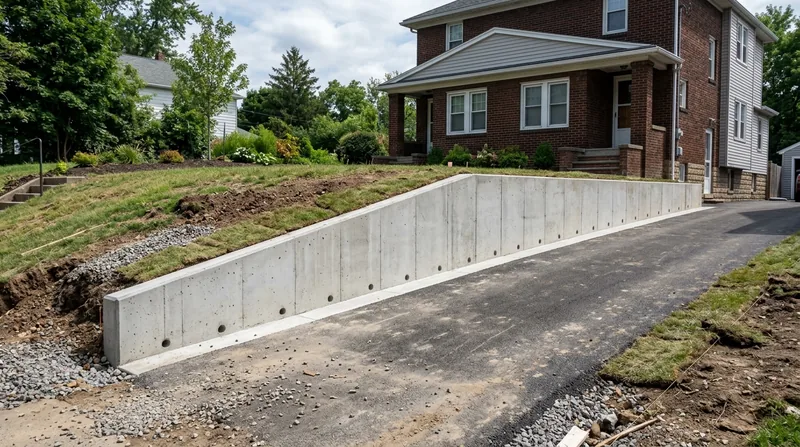




Concrete retaining walls in Buffalo are the workhorse solution for the steepest grade changes, the tallest cuts, and the toughest soil conditions across Western New York. Buffalo sits at the eastern edge of Lake Erie where the Niagara River begins, built on flat lake-plain clay and silt stepped by the limestone ledge of the Onondaga Escarpment through North Buffalo and Amherst. From the Victorian and Queen Anne homes of Allentown and Elmwood Village to the post-war ranches of Cheektowaga and the rolling Southtowns hills around Orchard Park and East Aurora, homeowners face relentless freeze-thaw cycles, deep frost, and lake-effect snowmelt that push walls out of line and crack timber and block year after year. Poured concrete and reinforced CMU walls go deep below frost depth with rebar and weep holes, holding firm against the pressures that break lesser materials. Buffalo Retaining Wall installs, repairs, and replaces concrete walls that anchor driveways, stabilize escarpment cuts, and shore up narrow lots in older neighborhoods where space is tight and grade changes are steep.
Why Concrete Retaining Walls Matter in Buffalo's Steep and Frozen Ground
Buffalo's terrain is defined by dramatic elevation changes and punishing winter conditions. The Onondaga Escarpment cuts through North Buffalo and Amherst, the Niagara Escarpment rises at Lockport and Lewiston, and the Southtowns roll with steep creek banks carved by Cazenovia, Eighteen Mile, and Buffalo creeks. When a homeowner builds on a cut lot or a hillside property, soil pressure, freeze-thaw cracking, and settling clay demand a wall that will not move. Concrete walls engineered to frost depth (typically 4 to 5 feet in Buffalo) with proper drainage and reinforcement are the only choice for tall walls, narrow lots, and driveway cuts that support vehicle weight.
- Concrete walls hold fast against deep frost heave and the lateral pressure of clay-rich Buffalo soil.
- Reinforced CMU and poured concrete support driveways, garages, and structures without settling or tilting.
- Proper footings below frost depth and weep holes prevent water buildup that cracks block and timber walls.
- Concrete walls last 50 to 100 years when built to code and maintained, outlasting timber and segmental block in harsh climates.
In Buffalo's freeze-thaw environment, concrete is not a luxury; it is the foundation of a wall that will still be standing when the house is sold.
Key info: Many Buffalo jurisdictions, including the City of Buffalo and towns like Amherst, Williamsville, and Cheektowaga, require a permit for retaining walls above 4 feet measured from the footing, or when a wall supports a surcharge such as a driveway. Engineered drawings are often required for tall or tiered walls. Always verify setback and property-line rules with your local building department before breaking ground. For details on Buffalo permitting, contact the City of Buffalo Department of Permit and Inspection Services.
How We Build Concrete Retaining Walls in Buffalo: Process and Precision
A concrete retaining wall is only as good as its foundation. We begin with a site survey to establish frost depth, soil bearing capacity, and drainage patterns. The footing is dug below the frost line (typically 4 to 5 feet in Buffalo), the subgrade is compacted, and rebar is laid to resist tension and bending. Whether we pour a monolithic concrete wall or build a reinforced CMU (concrete masonry unit) wall, the structure is engineered to hold back the soil pressure and the weight of whatever sits on top. Weep holes and drainage stone are installed behind the wall to manage groundwater, the enemy of frozen ground and clay soils.
- Excavate the footing trench below frost depth and compact the subgrade to remove air pockets.
- Set rebar in the footing and wall stem according to engineering plans, spacing and lap length verified.
- Pour concrete or lay CMU blocks to the finished height, backfill with drainage stone, and install weep holes.
- Compact backfill in 6-inch lifts to prevent settling, grade the top for drainage away from the wall.
- Allow concrete to cure fully before applying surcharge (driveway, structure, or heavy landscaping).
This methodical approach ensures the wall will not crack, lean, or settle under Buffalo's relentless freeze-thaw cycles.
Local example: A homeowner in West Seneca needed to stabilize a steep driveway cut on a property sloping toward Cazenovia Creek. The old timber wall had rotted and tilted after 25 years. We excavated below frost depth, poured a 6-foot reinforced concrete wall with weep holes and a 4-foot footing, and compacted engineered backfill. The driveway was resurfaced on top. Three years later, the wall is plumb, the driveway is solid, and the property is secure. Learn more about our retaining wall installation process.
Concrete Retaining Wall Methods and Materials
| Approach | Description | Best for |
|---|---|---|
| Poured Concrete Wall | Monolithic reinforced concrete poured in place with rebar, waterproofing, and weep holes. Footing extends below frost depth. Finished in 7 to 14 days. | Tall walls (6 to 12 feet), tight spaces, high surcharge loads, permanent installations in harsh freeze-thaw climates. |
| Reinforced CMU Wall | Concrete masonry units (concrete blocks) laid with mortar and rebar cells filled with concrete. Footings below frost depth. Finished in 5 to 10 days depending on height. | Moderate to tall walls (4 to 10 feet), faster construction, easier to adjust height in the field, good for escarpment cuts and driveway support. |
| Tiered Concrete Walls | Multiple concrete or CMU walls stacked with terraced backfill and drainage between tiers. Each wall independently engineered and footed below frost depth. | Very steep lots, hillside homes in Orchard Park and East Aurora, properties with multiple grade changes, maximum visual impact with stability. |
| Concrete Wall with Integrated Drainage | Poured or CMU wall built with a comprehensive drainage system: perforated drain tile behind the wall, gravel backfill, and weep holes every 4 to 6 feet. Ties into existing storm drainage or daylight. | High water table areas, creek banks, properties near Lake Erie bluffs, clay-rich soil that retains moisture, preventing hydrostatic pressure and frost heave. |
Concrete Retaining Walls Cost in Buffalo: What to Expect
Concrete retaining wall pricing in Buffalo starts at $35 per square foot for straightforward poured concrete or CMU walls in accessible locations with standard soil conditions and modest heights (4 to 6 feet). The total cost depends on wall height, linear footage, footing depth (which varies by location and frost line), soil type, drainage complexity, and site access. A 30-foot wall standing 6 feet tall on a level lot with good access and standard clay soil will run roughly $6,300 to $7,500. A 40-foot wall standing 8 feet tall on a steep escarpment cut with high water table and tight access can easily reach $12,000 to $16,000 or more.
Several factors move the price up from the baseline rate:
- Wall height and linear footage determine the volume of concrete, rebar, and labor required.
- Soil type and bearing capacity affect footing depth and the engineering required (clay and silt in Buffalo often need deeper footings and more robust drainage).
- Site access, existing utilities, and proximity to structures increase excavation time and safety precautions.
- Drainage complexity, including perforated tile, gravel backfill, and integration with existing storm systems, adds material and labor.
- Engineering and permit drawings are required for walls above 4 feet or supporting a surcharge; these fees range from $300 to $1,200 depending on complexity.
- Demolition of an existing failed wall (timber, block, or concrete) adds $2 to $5 per square foot of wall area.
We recommend getting 2 to 3 estimates from insured contractors in Buffalo. Each should include a site visit, a clear breakdown of materials and labor, the engineer's stamp if required, and a timeline. Do not choose based on price alone; a wall built to code and frost depth will outlast a bargain installation by decades. For a detailed pricing breakdown and to discuss your specific wall, visit our pricing page or call (716) 589-2564 for a free, no-obligation estimate.
Concrete Retaining Walls Near Me: What Buffalo Homeowners Should Know When Hiring a Contractor
Hiring the right contractor for a concrete retaining wall is a critical decision. The wall will sit on your property for 50 years or more, holding back soil and supporting structures. A poorly built wall will lean, crack, and fail within a decade, costing thousands to repair or replace. Start by verifying that the contractor is fully insured in New York State. Ask for proof of general liability and workers' compensation insurance. Request references from at least three recent jobs in Buffalo or nearby towns, and call those homeowners to ask about the contractor's communication, timeline, and how the wall has held up.
Before you sign, ensure the contractor understands Buffalo's permit requirements. If your wall exceeds 4 feet or will support a driveway or structure, a permit is required. The contractor should pull the permit and provide you with a copy of the approval and the engineer's drawings. Ask whether the contractor has worked with your local building department before and whether they understand frost depth, drainage requirements, and the specific soil conditions in your neighborhood. In Buffalo, Amherst, Cheektowaga, and West Seneca, frost depth is typically 4 to 5 feet, but this varies by exact location and must be verified during design.
- Verify that the contractor is licensed with the New York State Department of State and carries current general liability and workers' compensation insurance.
- Request a written estimate that breaks down materials, labor, equipment, and any engineering or permit fees separately.
- Confirm the contractor will obtain all required permits and provide you with a copy of the approved plans before construction begins.
- Ask about the contractor's warranty and what it covers (structural integrity, drainage, settlement) and for how long.
- Check with your local HOA or property deed for any restrictions on wall height, materials, or appearance before the contractor begins work.
- Request a timeline and understand how weather and site conditions might affect the schedule (concrete curing, backfill compaction, and drainage installation cannot be rushed).
A reputable contractor will be transparent about costs, timeline, and the technical requirements of your job. If a contractor avoids your questions about permits or frost depth, or offers a price that seems too low, move on. Contact Buffalo Retaining Wall for a free consultation. We will visit your property, explain what the wall needs to withstand Buffalo's climate, and provide a detailed estimate with no obligation to hire us.
Concrete Retaining Walls in Buffalo: Pricing Guide
| Service | Price | Details |
|---|---|---|
| Poured Concrete Wall (standard) | Starting at $35/sq ft | Includes footing below frost depth, rebar, concrete, and basic weep hole drainage for accessible sites with standard soil |
| Reinforced CMU Wall (block) | Starting at $32/sq ft | Concrete masonry units with mortar, rebar cells, and concrete fill; footing below frost depth; faster installation than poured |
| Concrete Wall with Advanced Drainage | Starting at $45/sq ft | Includes perforated drain tile, gravel backfill, and integration with storm drainage; required for high water table and clay soil |
| Demolition and Replacement | From $2 to $5/sq ft removal, plus new wall cost | Removal of failed timber, block, or concrete wall; disposal; site prep; new wall built to current code and frost depth |
| Engineering and Permits | From $300 to $1,200 | Professional engineer's design drawings and calculations required for walls above 4 feet or supporting surcharge; permit fees separate |
| Free Estimate and Consultation | No charge | Site visit, soil and drainage assessment, recommendations, and written quote; call (716) 589-2564 for response within 24 hours |
Indicative pricing, the exact cost depends on square footage, finish, and site access. Free personalized estimate within 24h at (716) 589-2564.


