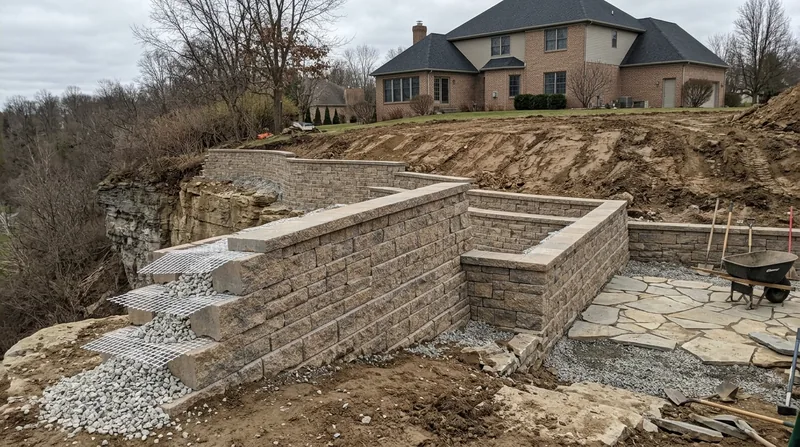




Retaining Wall Installation in Buffalo demands more than standard construction. Buffalo sits at the eastern end of Lake Erie where the Niagara River begins, built on flat lake-plain clay and silt stepped by the limestone ledge of the Onondaga Escarpment through North Buffalo, Amherst, and Williamsville. The terrain rises again at the Niagara Escarpment near Lockport and Lewiston, and rolls through the Southtowns hills of Orchard Park and East Aurora. Heavy lake-plain clay, deep frost cycles, relentless freeze-thaw, and lake-effect snowmelt (Snowvember 2014 and the December 2022 blizzard buried the region) push walls out of line under gray skies and bright green summers. A new retaining wall built here must sit on a footing below Western New York frost depth, with clean gravel backfill and drainage engineered for that clay. Buffalo Retaining Wall builds walls that hold for decades, not seasons.
Why Retaining Wall Installation Matters on Buffalo's Escarpment Lots and Creek Ravines
Buffalo's geography demands retaining walls. Homeowners on escarpment lots in North Buffalo and Williamsville face cuts and fills that need structural support. Creek ravines along Cazenovia, Eighteen Mile, and Buffalo creeks carve through backyards in the Southtowns. Sloped driveways and terraced yards in Orchard Park, East Aurora, and Lancaster require walls to prevent erosion and create usable space. Without proper installation, these walls fail within a few seasons, especially when freeze-thaw cycles crack concrete or when clay backfill holds water instead of draining it away.
- We set every footing below the Western New York frost depth (approximately 48 inches) to prevent heave and failure.
- We use clean gravel backfill and install perimeter drainage to shed water away from the wall face and through the clay.
- We build block, poured concrete, boulder, or timber walls to match your lot's grade and your home's architectural style.
- We handle permitting and engineered drawings for walls above 4 feet or walls supporting surcharges like driveways or structures.
A properly installed wall protects your property, adds usable outdoor space, and holds steady through Buffalo winters and spring thaw.
Local example: A homeowner in Williamsville with a sloped driveway cut needed a 6-foot segmental block wall to stabilize the grade and create a level parking area. We dug the footing 52 inches deep, installed a perforated drain pipe at the base, backfilled with clean stone, and compacted in 6-inch lifts. Two years later, the wall stands plumb and the driveway is solid.
For more information on maintaining existing walls or addressing wall failures, see our Retaining Wall Repair service.
The New York State Department of State maintains construction and contractor licensing information at dos.ny.gov. Always verify permit thresholds with your local Buffalo building department before design begins.
How We Build Retaining Walls in Buffalo: A Field-Proven Process
Retaining wall installation in Buffalo requires a methodical sequence that respects our soil, frost, and drainage realities. We start with a site assessment to understand the clay composition, groundwater behavior, and load on the wall (is it holding back a driveway, a slope, or just landscape soil?). We then mark the footing line, excavate to frost depth, compact the base, and build the wall with the material that fits your budget and aesthetic. Drainage is built in from day one, not added as an afterthought.
- We conduct a free site visit and assess the slope, soil type, and wall height needed to stabilize your grade.
- We obtain or help you obtain a permit from your local building department if the wall exceeds roughly 4 feet or supports a surcharge.
- We excavate the footing trench to below frost depth (48+ inches in Buffalo), compact the base, and set drainage stone.
- We build the wall face (block, poured concrete, boulder, or timber) in level courses, ensuring proper backslope and alignment.
- We backfill with clean gravel in 6-inch lifts, compact each lift, and install a perimeter drain pipe to manage subsurface water.
- We grade and finish the top of the wall, and we clean up all debris and excess soil.
The entire process, from excavation to final grading, typically takes 3 to 5 working days for a standard 4-to-6-foot wall on a residential lot.
Real Buffalo example: A homeowner in Kenmore with a steep backyard slope wanted to create a terraced garden and level patio. We built a tiered system with two 4-foot segmental block walls, each with its own perimeter drain. The lower wall sits 52 inches deep, the upper wall 48 inches deep. Both are backfilled with clean stone and compacted. The terraces now hold soil and plants without movement, even after heavy spring snowmelt.
For specific material options and their performance in Buffalo's climate, explore our Block & Segmental Retaining Walls and Concrete Retaining Walls pages.
| Approach | Description | Best for |
|---|---|---|
| Segmental Block (SRW) | Interlocking concrete blocks stacked and backfilled with gravel and drain tile. Flexible, absorbs minor movement, easy to repair individual units. | Residential lots, tiered yards, modern homes in Amherst and Clarence. Handles freeze-thaw well. |
| Poured Concrete | Monolithic cast-in-place wall with rebar reinforcement and integrated drainage. Rigid, long-lived, requires careful design for clay soils. | Tall walls (8+ feet), steep grades, driveway edges in Buffalo and Cheektowaga. High load-bearing capacity. |
| Boulder & Natural Stone | Stacked Medina sandstone, Onondaga limestone, or field boulders. Hand-set or dry-stacked. Fits historic neighborhoods and creek banks. | Allentown, Elmwood Village, lake bluffs, and creek ravines. Matches 1870s-1910s character. Aesthetically premium. |
| Timber (Pressure-Treated or Composite) | Horizontal or vertical timbers bolted together. Warm appearance, moderate cost, requires drainage and occasional maintenance. | Residential yards, ranch homes in Tonawanda and West Seneca. Not suitable for very tall or heavily loaded walls. |
Retaining Wall Installation Cost in Buffalo: What to Expect
Retaining wall installation in Buffalo typically starts at $30 per square foot for standard segmental block or timber walls on accessible lots with stable clay soil. A 4-foot-tall, 20-foot-long segmental block wall (80 square feet) runs approximately $2,400 to $3,200 installed, including footing, drainage, and backfill. Poured concrete walls cost more (often $40 to $60 per square foot) because they require formwork, rebar, and engineered design. Boulder and natural stone walls, hand-set by skilled masons, run $50 to $80 per square foot or more, depending on stone availability and complexity.
Several factors move the price up or down. Difficult access (narrow side yards, steep grades, or limited equipment room) adds labor and time. Tall walls (6 to 8 feet or higher) require engineered drawings and deeper footings, which increase cost. Poor drainage conditions or high groundwater require more elaborate perimeter drain systems. Permit delays or HOA reviews can add weeks to the timeline. Tight proximity to utilities, structures, or property lines demands careful excavation and may require hand-digging instead of machinery.
We recommend getting two to three estimates from insured contractors. Each estimate should detail the footing depth, backfill material, drain specifications, and any permits or engineering required. The cheapest estimate is often a sign that corners are being cut on drainage or frost depth. The most expensive may include unnecessary features. A mid-range estimate that explicitly covers footing depth, gravel backfill, and perimeter drain is usually the best value.
For a full breakdown of pricing by material and wall size, see our Pricing Overview.
What to Look for When Hiring a Retaining Wall Contractor Near Me in Buffalo
Hiring the right contractor is as important as choosing the right material. A retaining wall is a structural element that will sit on your property for 20, 30, or 40 years. It needs to be built by someone who understands Buffalo's frost, clay, and drainage challenges, not by a general contractor who treats it like a decorative feature.
Verify licensing and insurance. Ask to see proof of a current contractor's license from New York State and a certificate of insurance covering general liability and workers' compensation. Do not hire an unlicensed contractor, no matter how cheap the quote.
Get multiple estimates. Call at least two or three contractors and ask each one to visit your site, assess the soil and slope, and provide a written estimate that includes footing depth, backfill material, drain specifications, and any permits. Compare the estimates side by side. If one estimate is significantly lower, ask why.
Check references and past work. Ask the contractor for at least three homeowner references from the past two years. Call them and ask whether the wall still stands plumb, whether drainage works, and whether they would hire the same contractor again. If possible, drive by completed projects in your neighborhood (Buffalo, Amherst, Williamsville, or Kenmore) and look at the wall condition.
Understand permit requirements. Many Buffalo jurisdictions require a permit for walls above approximately 4 feet, or when a wall supports a surcharge such as a driveway or structure. Engineered drawings may be required for tall or tiered walls. Setback and property-line rules vary by zone. A good contractor will help you navigate the permit process and defer to your local building department on thresholds and rules. Never hire someone who promises to skip the permit process.
Confirm HOA and property-line compliance. If you live in a development with an HOA, check your covenants for wall height, material, and setback restrictions. Confirm your property line with a survey if there is any doubt. A wall built on the wrong property or in violation of HOA rules can be costly to remove and rebuild.
Ready to move forward? Contact Buffalo Retaining Wall for a free, no-obligation estimate. Call (716) 589-2564 or fill out our online form, and we will respond within 24 hours.
Retaining Wall Installation in Buffalo: Pricing Guide
| Service | Price | Details |
|---|---|---|
| Segmental Block Wall (SRW) | Starting at $30/sq ft | Standard 4-to-6-foot wall, accessible lot, includes footing, backfill, and perimeter drain. Taller or complex grades increase cost. |
| Poured Concrete Wall | Starting at $45/sq ft | Engineered monolithic wall with rebar, formwork, and drainage. Tall walls, heavy loads, or difficult access drive price toward $60+ per sq ft. |
| Boulder & Natural Stone Wall | Starting at $50/sq ft | Hand-set Medina sandstone, Onondaga limestone, or field stone. Premium material and skilled masonry labor; price varies with stone availability and complexity. |
| Timber Retaining Wall | Starting at $25/sq ft | Pressure-treated or composite timber, bolted construction. Lower cost entry point; not suitable for walls taller than 5-6 feet or heavy surcharge loads. |
| Complex or large-scale installation | On estimate | Tiered walls, very tall walls, poor drainage conditions, tight access, or engineered design require on-site assessment before pricing. |
| Free estimate and travel | No charge | Site visit, assessment, and written quote included at no cost. Travel within Buffalo service area included; response within 24 hours. |
Indicative pricing, the exact cost depends on square footage, finish, and site access. Free personalized estimate within 24h at (716) 589-2564.


