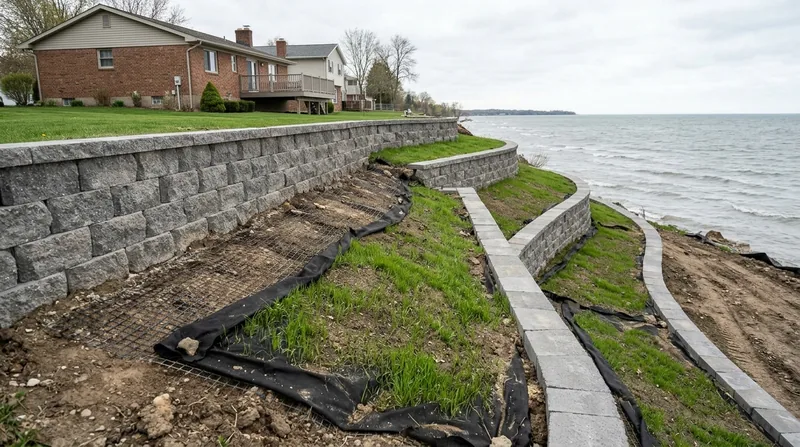




Slope Stabilization and Erosion Control in Buffalo protects homes, driveways, and yards from the relentless freeze-thaw cycles, heavy lake-effect snowmelt, and creek bank failures that dominate Erie County. Buffalo sits at the eastern end of Lake Erie where the Niagara River begins, built on flat lake-plain clay and silt stepped by the limestone ledge of the Onondaga Escarpment through North Buffalo, Amherst, and Williamsville. The Niagara Escarpment rises at Lockport and Lewiston, while the rolling Southtowns hills of Orchard Park, East Aurora, and Boston are cut by Cazenovia, Eighteen Mile, and Buffalo creeks. Every slope in this region faces the same enemy: deep frost, relentless freeze-thaw, and lake-effect snowmelt that push walls out of line and erode creek banks year after year. Buffalo Retaining Wall stabilizes slopes with terraced walls, geogrid reinforcement, and engineered drainage to stop soil loss and keep your property safe. Call us at (716) 589-2564 for a free estimate, or learn more about our retaining wall installation services.
Why Slope Stabilization Matters on Lake Erie Bluffs and Escarpment Edges in Buffalo
Buffalo homeowners face a unique slope challenge: the combination of Lake Erie storm waves eating at shoreline bluffs, creek ravines carved by Cazenovia and Ellicott creeks, and the escarpment edge itself all create unstable ground. A slope that looks stable in July can shift dramatically after Snowvember 2014 or the December 2022 blizzard when massive snowmelt saturates clay and silt. Uncontrolled erosion doesn't just ruin landscaping, it threatens foundations, driveways, and even the structural integrity of homes built on or near slopes.
- Freeze-thaw cycles crack and heave unprotected slopes, especially in clay-rich lake plains across Tonawanda, Cheektowaga, and West Seneca.
- Lake-effect snowmelt saturates soil and destabilizes slopes along the escarpment edge and creek banks from Lockport to Hamburg.
- Creek bank erosion from Cazenovia and Ellicott creeks undercuts yards in Buffalo, Orchard Park, and East Aurora.
- Ungraded slopes and failed timber walls from the 1970s and 1980s collapse under combined water pressure and soil weight.
- Terraced retaining walls with proper drainage redirect water away from footings and distribute load safely across the slope.
Addressing slope failure early prevents catastrophic property damage and expensive emergency repairs later.
Key info: A slope that drains poorly in winter becomes a liability by spring. Homeowners in Amherst, Clarence, and Williamsville often discover failed timber or railroad tie walls after the thaw exposes cracks, leaning sections, and soil loss that accelerated under freeze-thaw stress. Engineered slope stabilization stops this cycle before major settlement or foundation damage occurs. For more on addressing failed walls, see our leaning and collapsed wall repair service.
The Buffalo Building Department and Erie County Code require permits for retaining walls above roughly 4 feet measured from the footing, or when a wall supports a surcharge such as a driveway or structure. Engineered drawings are often required for tall or tiered walls. Always verify thresholds with your local building department before starting work. More information is available through the City of Buffalo Department of Permitting and Inspections.
How We Stabilize Slopes and Control Erosion in Buffalo
Slope stabilization begins with a site inspection to understand soil type, water flow, slope angle, and the cause of failure (freeze-thaw, groundwater, undercutting, or load). Buffalo's lake-plain clay and silt require different strategies than the limestone escarpment slopes in Lockport or the rolling terrain in Orchard Park. We design a system that addresses the root cause, not just the symptom, and we build it to survive the next blizzard and thaw cycle.
- We excavate and assess the existing slope, soil composition, and drainage patterns to determine failure mode and load requirements.
- We install a properly engineered retaining wall (terraced, if needed) with a reinforced base and proper setback from property lines and structures.
- We add geogrid reinforcement to the backfill to bind soil particles and distribute load across the wall and slope.
- We install a drainage system (perforated pipe and gravel) behind the wall to intercept groundwater and direct it away from the footing.
- We grade and compact the backfill in lifts to eliminate voids and ensure long-term stability under freeze-thaw and snowmelt stress.
- We vegetate or armor the slope face with sod, erosion control blanket, or riprap to stop surface runoff and further soil loss.
This multi-layer approach stops erosion at the source and keeps your slope stable for decades.
Local example: A homeowner in West Seneca had a 6-foot slope behind their driveway that was cracking and settling after heavy spring snowmelt. The old landscape timber wall was failing, and water was pooling at the base. We replaced it with a terraced segmental block wall, installed geogrid and drainage behind it, and graded the slope to shed water away from the driveway. The wall has held solid through three winters, and no new settlement has occurred. This is the standard we deliver across Buffalo, Kenmore, and Cheektowaga.
For detailed guidance on materials and design, see our retaining wall drainage service page.
Slope Stabilization Methods and Materials
| Approach | Description | Best for |
|---|---|---|
| Terraced Block Walls | Segmental retaining wall blocks stacked in tiers, each tier stepped back and reinforced with geogrid to distribute load and prevent toppling under freeze-thaw stress. | Moderate to steep slopes in Amherst, Williamsville, and Clarence where freeze-thaw is the primary failure mode. |
| Poured Concrete Walls | Monolithic concrete retaining wall with reinforced steel, engineered footing, and integral drainage to resist lateral soil pressure and freeze-thaw heave. | High-load applications, driveway cuts, and slopes supporting structures in Buffalo and North Buffalo. |
| Boulder and Natural Stone Walls | Large Medina sandstone or Onondaga limestone boulders mortared or stacked dry with geogrid and drainage, creating a visually integrated slope stabilization. | Creek banks, lake bluffs, and escarpment slopes in Lockport, Lewiston, and Orchard Park where natural aesthetics matter. |
| Geogrid and Soil Reinforcement | High-strength synthetic mesh embedded in slope backfill to bind soil particles, increase internal friction, and distribute loads across the wall base and underlying soil. | All slopes, especially clay-rich lake plains where soil cohesion is low and freeze-thaw destabilizes unreinforced fills. |
| Erosion Control Blanket and Vegetative Armoring | Biodegradable or synthetic mesh applied to the slope face, seeded with native grasses and shrubs to bind surface soil and reduce runoff velocity. | Slopes subject to surface erosion from snowmelt and rain, especially along Cazenovia and Ellicott creeks in East Aurora and Hamburg. |
| Perforated Drain Pipe and Gravel Backfill | Engineered drainage system installed behind the wall to intercept groundwater, direct it away from the wall footing, and prevent hydrostatic pressure buildup. | All retaining walls in Buffalo, especially those supporting saturated clay or silt or exposed to lake-effect snowmelt. |
Slope Stabilization and Erosion Control Cost in Buffalo: What to Expect
The cost of slope stabilization depends on slope height, length, soil type, existing conditions, and the method you choose. A small terraced wall on a residential slope in Kenmore may run significantly less than a tall engineered wall supporting a driveway cut in Buffalo or an escarpment stabilization in Lockport. We provide a free estimate after an on-site inspection, and we respond within 24 hours at (716) 589-2564.
Factors that affect cost include: slope height and length (measured in linear feet), soil type and stability (clay-rich lake plains require more robust drainage than sandy escarpment soils), whether the slope already has a failed wall or is uncontained, proximity to structures or utilities, access for equipment and materials, and permit requirements (engineered drawings for tall walls add cost but are legally required). A single-tiered terraced wall on a moderate slope in a newer subdivision may cost less than a complex multi-tiered system on an escarpment edge or creek bank.
We recommend getting 2 to 3 estimates from insured contractors so you understand the range and the reasoning behind each bid. Some contractors may bid lower by cutting corners on drainage or geogrid reinforcement, which leads to failure after the first harsh winter. Our estimates include all materials, labor, drainage, and compaction, so you know exactly what you are paying for.
For a detailed breakdown of pricing by project type and scope, see our full pricing overview. To request a free estimate, contact us at (716) 589-2564 or visit our contact page.
Slope Stabilization and Erosion Control Near Me: What Buffalo Homeowners Should Know When Hiring a Contractor
Hiring the right contractor for slope stabilization is critical because a poorly designed or built wall will fail within a few winters under Buffalo's freeze-thaw and snowmelt stress. Look for a contractor who is fully insured for retaining wall work in New York, who understands local soil conditions and drainage challenges, and who provides a written estimate that details materials, methods, and warranty. Ask for references from homeowners in your area (Amherst, Williamsville, Clarence, Tonawanda, Kenmore, or Cheektowaga) and verify that the contractor has completed similar projects on slopes with comparable exposure and soil type.
- Confirm the contractor is fully insured and carries liability and workers compensation insurance.
- Ask whether the contractor will obtain permits and work with the local building department, or whether you are responsible for permitting.
- Request a written estimate that specifies materials (block type, geogrid grade, drainage pipe diameter), labor days, and a completion timeline.
- Check references from at least three recent projects on slopes similar to yours in Buffalo, Orchard Park, East Aurora, or other local terrain.
- Ask about warranty: most reputable contractors offer 5 to 10 year warranties on materials and workmanship for slope stabilization.
- Verify that the contractor understands HOA requirements or neighborhood design guidelines if your property is subject to them.
- Confirm that the estimate includes site grading, drainage design, and compaction, not just wall installation.
Buffalo Retaining Wall is fully insured, and we provide a free, no-obligation estimate within 24 hours. Call us at (716) 589-2564 or request a free estimate online. We serve Buffalo, Amherst, Williamsville, Clarence, Tonawanda, Kenmore, Cheektowaga, West Seneca, Lackawanna, Hamburg, Orchard Park, East Aurora, Lancaster, Depew, Elma, Grand Island, Lockport, North Tonawanda, Niagara Falls, and Lewiston.
Slope Stabilization & Erosion Control in Buffalo: Pricing Guide
| Service | Price | Details |
|---|---|---|
| Site Inspection and Estimate | Free | Includes slope assessment, soil evaluation, drainage review, and written estimate with no obligation to book |
| Terraced Block or Concrete Wall (small to medium) | Starting at $3,500 | Single or double tier, up to 30 linear feet, includes geogrid, drainage, and compaction labor for moderate slopes |
| Terraced Block or Concrete Wall (large or complex) | On estimate | Multi-tier systems, slopes over 30 linear feet, escarpment or creek bank work, or walls supporting driveways require site-specific engineering and pricing |
| Boulder or Natural Stone Stabilization | On estimate | Material cost and labor vary by stone type, slope length, and aesthetic requirements; engineered placement with geogrid and drainage adds labor |
| Travel and Mobilization | Included | No separate mileage or travel fee for jobs in Buffalo and surrounding Erie County service areas |
| Emergency or Urgent Repair | On estimate | Same-day or next-day response for failed walls or active erosion threatening structures; expedited scheduling may apply |
Indicative pricing, the exact cost depends on square footage, finish, and site access. Free personalized estimate within 24h at (716) 589-2564.


