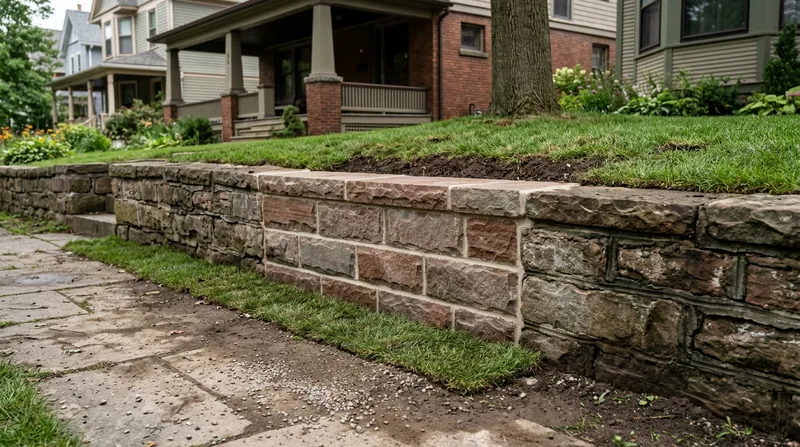




Retaining Wall Repair in Buffalo stops the freeze-thaw cycle from pushing your wall further out of line. Western New York's lake-effect winters, deep seasonal frost, and relentless ground heave create conditions that crack, bow, and tilt walls built from concrete, block, stone, or timber. Buffalo's mix of 1870s Victorian homes with garden walls in Allentown, post-war ranches with driveway-cut retaining walls in Cheektowaga and West Seneca, and newer two-story subdivisions across Amherst and Clarence all face the same enemy: water behind the wall, freeze cycles that expand soil, and the slow collapse of drainage systems. When a wall leans, cracks horizontally, or bulges at the base, the structural failure has already begun. We repair leaning walls, correct drainage, add tieback anchors, or rebuild only the failed span so the wall stops moving and your yard stays stable. Call (716) 589-2564 for a free estimate, or learn more about retaining wall installation if you're considering a new wall.
Why Retaining Wall Repair Matters in Buffalo's Lake-Effect Climate
Buffalo's location at the eastern end of Lake Erie creates a perfect storm for wall failure. The lake-plain clay and silt that dominate the flat terrain from downtown Buffalo through Kenmore and Tonawanda hold water and expand under frost. The Onondaga Escarpment that rises through North Buffalo, Williamsville, and Clarence brings limestone ledges and steeper slopes where gravity and water pressure compound the stress. Snowvember 2014 and the December 2022 blizzard dumped snow that melted into saturated soil, pushing walls outward. Lake-effect snowmelt and spring thaw cycle water through the soil behind your wall every year, and each freeze cycle heaves the soil another fraction of an inch.
- A bowing or bulging wall signals that soil pressure and water are overwhelming the structure.
- Horizontal cracks in concrete or block indicate differential settlement and lateral thrust from saturated ground.
- Leaning walls accelerate once they start moving, often failing completely within one to three seasons if not repaired.
- Failed drainage behind the wall is the root cause in 80 percent of Buffalo-area repairs we perform.
- Tieback anchors and geogrid reinforcement can restore a wall without full demolition and rebuild.
Early repair stops the progression and saves you thousands in replacement costs down the road.
Key info: A wall leaning 2 to 4 inches in Buffalo often fails completely within 18 to 36 months if drainage is not corrected and tieback anchors are not installed. The freeze-thaw cycle does not slow down; it accelerates the tilt. We recommend a structural assessment as soon as you notice movement. See the New York State Department of Environmental Conservation for slope stability guidance in your municipality.
How We Repair Retaining Walls in Buffalo: Our Process
We begin with a site visit to measure the lean, identify cracks, and dig test pits to evaluate the soil and drainage behind the wall. Buffalo's clay-heavy soils and the depth of frost penetration (24 to 36 inches in most years) require us to understand what's happening below grade. We photograph the wall, take measurements, and assess whether the failure is drainage-only, structural, or both. Once we understand the cause, we design a repair strategy that matches the wall type, the slope behind it, and your budget.
- We expose the wall face and probe behind it to confirm soil saturation and drainage conditions.
- We install or restore underdrain systems, using perforated pipe and gravel to move water away from the wall.
- We add tieback anchors (steel cables or rods anchored deep into stable soil) to pull the wall back to plumb.
- We rebuild or reinforce the face if concrete is spalling, block is cracked, or stone has shifted.
- We compact backfill in lifts, sloping the grade away from the wall to shed surface water.
- We test the wall for movement before we consider the job complete.
This approach preserves most of the original wall while addressing the actual cause of failure.
Local example: A homeowner in Orchard Park had a 6-foot Medina sandstone garden wall tilting 3 inches at the top. The soil behind it was saturated clay. We installed an underdrain system along the base, added two tieback anchors into the stable bedrock below, and reset the top course of stone. The wall returned to plumb, and the homeowner avoided a $12,000 full rebuild. Total repair cost was $4,200. See retaining wall drainage solutions for more on how we manage water.
Repair Methods for Different Wall Types and Failure Modes
| Approach | Description | Best for |
|---|---|---|
| Underdrain Installation | Perforated pipe and aggregate behind the wall to intercept and route water away from the soil mass. | Walls failing due to saturation and frost heave; the most common Buffalo scenario. |
| Tieback Anchors | Steel cable or rod anchored deep into stable soil or bedrock, then tensioned to pull the wall back to plumb. | Bowing or leaning walls where the structure is sound but lateral pressure is too high to resist. |
| Partial Rebuild | Remove and rebuild only the failed section of the wall, reusing sound stone or block from the original. | Localized cracking, spalling, or settlement in one span; preserves historic walls in Buffalo's Allentown and Elmwood Village. |
| Geogrid Reinforcement | High-strength plastic mesh layers embedded in backfill to distribute load and prevent lateral bulging. | Segmental block walls and newer retaining walls that can be reinforced without full removal. |
| Face Repair and Sealing | Clean, reset, or repoint concrete, stone, or block; apply sealant to prevent water infiltration and freeze damage. | Cosmetic and protective work on sound walls with minor cracking or water staining. |
The right repair method depends on the wall material, the degree of lean, soil conditions, and your timeline. We assess all factors during the free site visit and present options with cost and durability trade-offs.
Retaining Wall Repair Cost in Buffalo: What to Expect
Retaining wall repair in Buffalo starts at around $1,500 for minor drainage work on a short wall and can range to $8,000 to $12,000 for a full structural repair with tieback anchors and partial rebuild. The cost depends on how far the wall has tilted, whether the structure is still sound or needs rebuilding, soil conditions, and access for equipment. A wall that is leaning 2 inches with saturated soil behind it costs less to repair than a wall leaning 4 inches with cracked concrete that requires reinforcement and face work. Tieback anchors add $800 to $2,000 per anchor, depending on depth and soil type. Underdrain installation typically runs $2,500 to $5,000 for a 30-foot wall, depending on how much of the wall needs exposure and backfill work.
We always recommend getting 2 to 3 estimates before committing to a repair. Different contractors may propose different solutions (full rebuild versus targeted repair), and the price will reflect those choices. When you call for an estimate, ask the contractor to explain why they are recommending a particular approach. A cheap quote that skips drainage correction will leave you with a wall that fails again in two years. A comprehensive repair that addresses drainage, adds anchors, and reinforces the face will hold for 20 to 30 years. See our full pricing guide for more detail on what drives cost up or down.
Cost reality: A 40-foot concrete wall in West Seneca leaning 3 inches with horizontal cracks typically costs $5,500 to $7,500 to repair with underdrain, tieback anchors, and face sealing. A 20-foot stone wall in Kenmore with minor drainage issues and a 1-inch lean costs $2,200 to $3,500 for underdrain and repointing. Full replacement of the same walls would cost $12,000 to $18,000 and $6,000 to $9,000 respectively. Early repair saves money.
Retaining Wall Repair Near Me: What Buffalo Homeowners Should Know When Hiring
When you hire a contractor for retaining wall repair, verify that they are fully insured and carry general liability and workers' compensation insurance. Ask to see the certificate of insurance before work starts. Request references from at least two previous wall repair jobs in Buffalo or the surrounding towns, and call those references to ask about drainage performance and whether the wall has moved since repair. If your wall is over 4 feet tall or supports a driveway or structure, check with your local building department to see whether a permit is required. Many Buffalo neighborhoods, including parts of Allentown, Elmwood Village, and the Delaware District, have historic district or HOA rules that may govern how the wall can be repaired or whether replacement materials must match the original. Ask the contractor whether they will handle permitting and coordinate with your HOA or historic preservation board.
- Confirm the contractor is fully insured and has worked on retaining walls for at least five years.
- Request written estimates that break down labor, materials, and the specific repair methods being proposed.
- Ask whether the contractor will install an underdrain system; if not, ask why drainage is not part of the repair.
- Verify that tieback anchors or other reinforcement will be installed if the wall is leaning more than 2 inches.
- Confirm the warranty on the repair work and the timeline for completion.
- Check whether your local building department requires a permit and whether the contractor will pull it.
A reputable contractor will answer these questions clearly and provide a written scope of work before you sign a contract. Contact us at (716) 589-2564 or visit our contact page to schedule a free, no-obligation estimate. We are fully insured, and we provide written estimates and a one-year warranty on all repair work.
Retaining Wall Repair in Buffalo: Pricing Guide
| Service | Price | Details |
|---|---|---|
| Underdrain System Installation | Starting at $2,500 | Perforated pipe, aggregate, and gravel backfill for walls up to 30 feet; most common Buffalo repair solution |
| Tieback Anchor Installation | Starting at $800 per anchor | Steel cable or rod anchored into stable soil or bedrock; cost varies with depth and number of anchors needed |
| Partial Wall Rebuild and Repair | Starting at $3,500 | Remove and rebuild failed section; includes drainage, repointing, and face work; cost rises with wall height and material |
| Full Structural Repair with Reinforcement | Starting at $5,500 | Underdrain, tieback anchors, geogrid, and face repair combined; typical for walls leaning 3 inches or more |
| Free Estimate and Site Assessment | Free | Response within 24 hours at (716) 589-2564; includes measurement, soil evaluation, and written repair recommendation |
Indicative pricing, the exact cost depends on square footage, finish, and site access. Free personalized estimate within 24h at (716) 589-2564.


