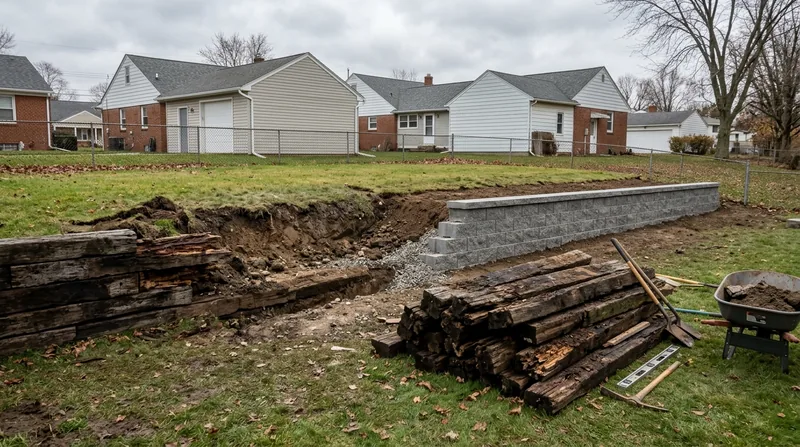




Railroad Tie Wall Replacement in Buffalo addresses one of the most common landscape failures across Erie County. Thousands of homes built in the 1980s and 1990s in Buffalo, Amherst, Williamsville, and the surrounding towns relied on creosote-treated railroad ties to hold back clay slopes and stabilize driveways. Those ties are now rotting, leaning, and failing under Buffalo's freeze-thaw cycles, lake-effect snowmelt, and the weight of deep clay soils. The Onondaga limestone ledge that steps through North Buffalo and the Niagara Escarpment at Lockport create steep cuts and terraced yards that demand solid walls. When your railroad tie wall starts to lean, separate, or sink, the soil behind it moves, driveways crack, and erosion accelerates. We remove the failed ties, haul them away, and rebuild your wall in durable block, concrete, or Medina sandstone with proper drainage and gravel backfill.
Why Railroad Tie Walls Fail in Buffalo's Lake-Plain Climate
Buffalo sits at the edge of Lake Erie where freeze-thaw cycles run deep and relentless. The lake-plain clay and silt that underlie most of the city hold water and expand when frozen, pushing walls outward. The creosote railroad ties installed decades ago were never engineered for permanent support; they were a budget solution that lasted 30 to 40 years at best. Heavy snowmelt from lake-effect storms, combined with the weight of wet clay behind the wall, overloads the ties and causes them to rot from the inside out.
- Creosote ties absorb water and decay faster in Buffalo's wet winters than in drier regions.
- Freeze-thaw cycles crack and split the wood, breaking the bond between ties and allowing soil to escape.
- Deep clay soils exert constant hydrostatic pressure that wood walls cannot withstand long-term.
- Backfill without drainage channels water directly into the wall, accelerating rot and settlement.
- Ties installed in the 1980s and 1990s are now 30 to 40 years old and at the end of their service life.
Waiting for a railroad tie wall to fail completely leads to expensive emergency repairs, soil loss, and damage to driveways or structures.
Key info: A leaning or separated railroad tie wall in Buffalo typically needs replacement within one to two seasons. Delaying the work risks sudden collapse during spring thaw or after heavy lake-effect snow. Check your wall now if it was installed before 2000. See our Leaning and Collapsed Wall Repair page for emergency stabilization options.
For permit and regulation details specific to your property, contact the City of Buffalo Department of Development Services or your town's building department. Walls over 4 feet or supporting a surcharge like a driveway often require a permit and may need engineered drawings.
How Buffalo Retaining Wall Replaces Railroad Tie Walls
Our process removes the failed ties completely and rebuilds the wall to modern standards. We start with a site visit to assess the wall height, soil conditions, and drainage needs. Then we remove the ties and haul them away, excavate the base, and prepare a solid footing. The new wall is built in your choice of material, backfilled with gravel and a drainage system, then compacted and finished.
- We inspect the wall and measure its height, length, and the soil slope behind it.
- We remove and haul away all creosote railroad ties and any deteriorated wood or soil.
- We dig a level footing below the frost line to prevent heaving in Buffalo winters.
- We build the new wall in segmental block, poured concrete, or stacked Medina sandstone.
- We install perforated drainage pipe and backfill with clean gravel to manage water pressure.
- We compact the backfill and grade the site to slope water away from the wall.
The entire process typically takes one to two weeks, depending on wall size and site access.
Example: A homeowner in Cheektowaga had a 40-foot railroad tie wall holding back a driveway. The ties were leaning inward and the driveway had cracked. We removed the old ties, built a new 4-foot segmental block wall with a perforated drain system, and finished the job in 10 days. The driveway settled back to level and has remained stable for three years.
If your wall also needs slope stabilization or erosion control work, we offer comprehensive slope stabilization services to protect the soil above and around the new wall.
Materials and Methods for Railroad Tie Wall Replacement
Three main approaches work well in Buffalo's climate. Each offers different durability, appearance, and cost. Your choice depends on the wall height, the load it carries, and your budget and aesthetic preferences.
| Approach | Description | Best for |
|---|---|---|
| Segmental Block (SRW) | Interlocking concrete blocks stacked dry and backfilled. Flexible, durable, and engineered for long-term performance in clay soils. | Walls 4 to 12 feet tall, residential and light commercial, driveways and terraced yards. |
| Poured Concrete | Reinforced concrete wall cast in place, monolithic, and extremely strong. Handles freeze-thaw stress well and requires minimal maintenance. | Tall walls, heavy loads, tight spaces, and homeowners who want minimal upkeep. |
| Medina Sandstone | Stacked natural stone from local quarries, hand-fitted for appearance and durability. Classic Buffalo aesthetic that blends with older neighborhoods. | Historic districts, Allentown and Elmwood Village, and homeowners seeking natural stone character. |
| Timber (New Pressure-Treated) | Modern pressure-treated timber or composite materials, engineered and rated for 25 to 40 years. Not creosote, but modern pressure treatment with much longer life. | Short walls under 3 feet, aesthetic preference for wood, and budgets below block or concrete. |
Each material is installed with a gravel backfill and perforated drainage pipe to manage water pressure and prevent the freeze-thaw failures that destroyed your original wall. See our Retaining Wall Drainage page for more on how proper drainage protects your investment.
Railroad Tie Wall Replacement Cost in Buffalo: What to Expect
Railroad tie wall replacement in Buffalo typically starts at $35 per square foot for segmental block walls with standard drainage. The total cost depends on wall height, length, material choice, site access, and whether the footing requires special preparation in clay or near structures. A 40-foot wall that is 4 feet tall runs roughly 160 square feet, so budget $5,600 to $7,200 for a block replacement with drainage. Poured concrete and Medina sandstone cost more per square foot but last longer and often justify the investment.
Factors that move the price up or down include the wall height (taller walls cost more per square foot due to engineering and reinforcement), the depth of the footing (clay soils in Buffalo often require footings 3 to 4 feet deep to get below the frost line), access (tight spaces or steep slopes add labor), and the material you choose. If the wall supports a driveway or structure, an engineer may need to design the wall, which adds a few hundred dollars but ensures it will not fail.
We always recommend getting two to three estimates before deciding. Our estimate is free and takes 15 to 30 minutes on-site. Call us at (716) 589-2564 or visit our pricing page for a detailed breakdown by material and size. We respond within 24 hours and never pressure you to book.
What to Look for When Hiring a Railroad Tie Wall Replacement Contractor Near Me in Buffalo
Replacing a railroad tie wall is not a DIY job. The wall must be built to code, properly drained, and anchored below the frost line to survive Buffalo winters. When you call a contractor, verify that they are fully insured, ask for references from similar jobs, and confirm they understand local permit requirements. Many towns in Erie County require a permit for walls over 4 feet or walls that support a surcharge like a driveway.
- Confirm the contractor carries liability insurance, valid in New York State.
- Ask for at least three references from residential retaining wall jobs completed in the past three years.
- Request a written estimate that breaks down labor, materials, and disposal costs separately.
- Verify that the contractor will pull the required permit from your town or city building department.
- Clarify whether the estimate includes a site survey and whether an engineer will design the wall if needed.
- Check if the contractor offers a warranty on the wall and for how long (typically one to three years on labor and materials).
A reputable contractor will explain why the old wall failed and how the new wall addresses those failures. They will not rush you or offer a price without seeing the site. If you have an HOA or live in a historic district, ask the contractor about any design or material restrictions before you sign a contract.
Ready to get started? Contact us for a free estimate or call (716) 589-2564. We serve Buffalo, Amherst, Williamsville, Clarence, Tonawanda, Kenmore, Cheektowaga, West Seneca, Lackawanna, Hamburg, Orchard Park, East Aurora, Lancaster, and surrounding areas.
Railroad Tie Wall Replacement in Buffalo: Pricing Guide
| Service | Price | Details |
|---|---|---|
| Segmental Block Wall Replacement | Starting at $35/sq ft | Includes excavation, footing, block installation, perforated drain, gravel backfill, compaction, and site finish for walls up to 6 feet tall |
| Poured Concrete Wall Replacement | Starting at $45/sq ft | Includes reinforced concrete footing and wall, drainage system, backfill, and finish; handles taller walls and heavy loads in Buffalo clay |
| Medina Sandstone Wall Replacement | Starting at $50/sq ft | Includes hand-fitted local stone, footing, drainage, and gravel backfill; premium material for historic neighborhoods and custom appearance |
| Engineered Design and Permit | On estimate | Required for walls over 6 feet or walls supporting driveways, structures, or pools; engineer fee typically $300 to $800 depending on complexity |
| Haul-Away and Disposal | Included | Creosote railroad ties and excavated soil are removed from your property and disposed of at licensed facilities; no separate charge |
| Free Estimate | No cost | On-site visit, site survey, material options, and written estimate with no obligation to book; response within 24 hours at (716) 589-2564 |
Indicative pricing, the exact cost depends on square footage, finish, and site access. Free personalized estimate within 24h at (716) 589-2564.


