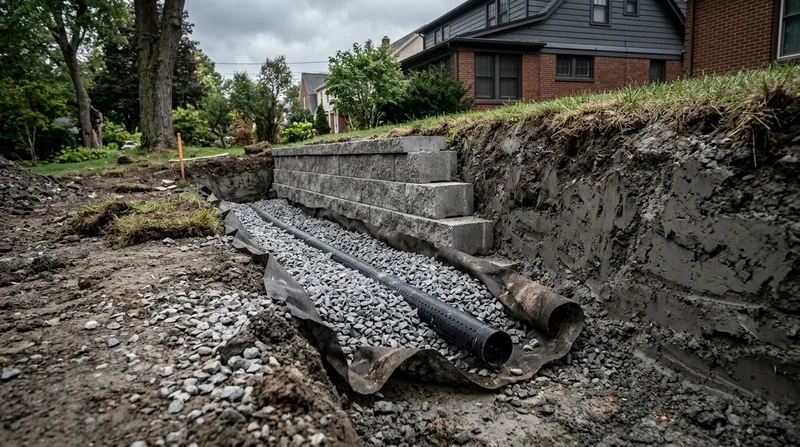




Retaining Wall Drainage in Buffalo is not optional, it is the difference between a wall that stands for decades and one that leans, cracks, and fails within years. Buffalo sits at the eastern end of Lake Erie where heavy lake-plain clay, deep winter frost, and relentless freeze-thaw cycles push water against every retaining wall in the region. From the Victorian mansions of Allentown to the frame cottages of South Buffalo, from the newer subdivisions of Amherst and Clarence to the post-war ranches of Cheektowaga and West Seneca, walls fail not because of poor construction but because water and frost pressure overwhelm them. A properly drained wall sheds water before it becomes a problem. Without drainage, hydrostatic pressure and ice lens formation crack mortar, heave footings, and tilt walls forward. We install and repair drainage systems that keep walls standing by removing the water and frost force that destroys them.
Why Retaining Wall Drainage Fails in Buffalo's Heavy Clay and Freeze-Thaw Climate
Buffalo's lake-plain clay holds water like a sponge. When that water freezes, it expands with tremendous force, pushing against the back of a retaining wall. In spring, snowmelt and rain pour into the soil behind the wall. By summer, the wall leans. By fall, cracks open. Most walls we repair have never been drained properly, or the original drainage system has clogged with silt and clay sediment over 20 or 30 years. The failure mode in Buffalo is not structural design, it is water and frost pressure that engineers can predict but poor drainage cannot handle.
- Water trapped behind a wall in clay soil creates hydrostatic pressure that pushes the wall forward and down.
- Freeze-thaw cycles in Buffalo winters cause ice lenses to form in saturated soil, heaving the wall upward and tilting it out of plumb.
- Clogged or missing drainage allows water to pool at the wall base, eroding the footing and weakening the soil beneath.
- Proper drainage extends wall life by 30 to 50 years and often prevents the need for a full rebuild.
The good news is that drainage repair is faster and cheaper than replacement.
Key info: A 1920s brick home in North Buffalo had a 12-foot Medina sandstone garden wall leaning 2 inches out of plumb after 15 years of no drainage. We installed a French drain at the base, added gravel backfill and filter fabric, and tied it to the storm sewer. The wall stopped moving within one season and remains stable today. No rebuild was needed.
For more detail on wall problems and solutions, see our page on Leaning and Collapsed Wall Repair.
According to the New York State Department of Environmental Conservation and local Buffalo building departments, drainage systems for retaining walls above 4 feet or supporting a surcharge (driveway, structure, or utility) often require engineering and a building permit. Always verify requirements with your local building department before beginning work.
How We Install and Repair Retaining Wall Drainage in Buffalo
A proper drainage system has three parts: collection (removing water from behind the wall), transport (moving it away safely), and dissipation (releasing it into the storm sewer or daylight). We design each system for Buffalo's clay and frost conditions. Some walls need only weep holes and gravel backfill. Others need a full French drain with perforated pipe, filter fabric, and a storm outlet. We inspect the existing wall, test soil drainage, and recommend the approach that solves the problem without unnecessary cost.
- We excavate behind the wall to expose the footing and assess soil saturation and existing drainage failures.
- We install a perforated French drain pipe at or below the footing, wrapped in filter fabric to prevent clay clogging.
- We backfill with clean 3/4-inch gravel to create a drainage layer that moves water down and away from the wall.
- We tie the drain to an existing storm sewer, daylight outlet, or dry well, ensuring water flows away from the property and neighboring walls.
- We install or repair weep holes through the wall face to allow any residual water behind the wall to escape before it freezes.
The result is a wall that sheds water and resists frost pressure.
Example: A timber retaining wall in Orchard Park holding back a steep slope was showing vertical cracks and a bulge in the middle. We removed the old landscape timber, installed a new segmental block wall with a full French drain system, and tied the drain to the property's existing storm line. The slope now drains properly, and the new wall is engineered to handle another 40 years of Buffalo winters.
For details on wall replacement and material options, visit our Retaining Wall Replacement page.
| Drainage Approach | Description | Best For |
|---|---|---|
| Weep Holes Only | Small-diameter pipes or tubes drilled through the wall face at regular intervals to allow trapped water to escape. | Shorter walls (under 6 feet) with light surcharge and minimal site water flow. |
| Gravel Backfill and Filter Fabric | Clean 3/4-inch gravel behind the wall with geotextile filter fabric to separate gravel from clay soil, allowing water to drain down and away. | Walls in clay soil where water needs a clear path to the base without clogging from fine sediment. |
| French Drain with Perforated Pipe | Perforated PVC or HDPE pipe laid at or below the footing, wrapped in filter fabric, surrounded by gravel, and tied to an outlet (storm sewer or daylight). | Tall walls (6+ feet), heavy surcharge, or properties with poor natural drainage or high water table. |
| Tiered or Benched Drainage | Multiple French drains at different elevations behind stepped or terraced walls, each with its own outlet, to manage water at each level. | Multi-tiered walls on steep slopes or where water must be intercepted at multiple points to prevent pressure buildup. |
| Dry Well or Catch Basin | An underground pit or chamber that collects drainage water and allows it to percolate into the soil or be pumped away. | Properties where a storm sewer connection is not available or where water must be stored and dispersed slowly. |
Retaining Wall Drainage Cost in Buffalo: What to Expect
Retaining wall drainage work in Buffalo typically starts at $2,500 for a basic system on a shorter wall (under 6 feet) with simple access and an existing storm outlet nearby. Most residential jobs in Buffalo, Amherst, Williamsville, and surrounding towns fall between $3,500 and $7,500, depending on wall height, soil conditions, drainage complexity, and whether an outlet requires trenching or a new connection. Tall walls on steep slopes, multi-tiered systems, or properties requiring a new storm sewer tie-in or dry well installation can reach $10,000 to $15,000 or more. The cost reflects the labor to excavate, install pipe and fabric, backfill with clean gravel, and ensure proper water flow away from the wall and your property.
Factors that increase cost include wall height, difficult site access (narrow yards, mature trees, existing structures), soil type and saturation testing, distance to a storm outlet, and whether the property is on a hillside or in a flood-prone area. We always recommend getting two or three estimates from insured contractors so you can compare approaches and pricing. See our full pricing overview for more detail.
Retaining Wall Drainage Near Me: What Buffalo Homeowners Should Know When Hiring
When you search for retaining wall drainage near Buffalo, you are looking for a contractor who understands Buffalo's clay, frost, and water table. The best contractors are fully insured, carry general liability and workers' compensation coverage, and can show you references from similar projects in your neighborhood. Ask to see photos of completed drainage work, not just the finished wall. Understand whether your project requires a building permit (walls over 4 feet usually do) and confirm that your contractor will pull the permit and handle the building department inspection. If you live in a neighborhood with HOA rules or historic district guidelines, clarify that before you begin. A good contractor will walk you through the estimate, explain why they chose a particular drainage approach, and give you a realistic timeline.
- Verify that the contractor is licensed in New York and carries current liability and workers' compensation insurance.
- Ask for at least three references from Buffalo-area homeowners with similar wall types and drainage challenges.
- Get written estimates from at least two contractors so you can compare methods, materials, and price.
- Confirm whether a building permit is required for your wall height and surcharge, and ask the contractor to handle the permit process.
- Check that the contractor understands local drainage ordinances and can tie the system to the correct outlet without violating property-line or easement rules.
Fully insured contractors stand behind their work and carry the right insurance if something goes wrong. We recommend contacting us for a free, no-obligation estimate. Call (716) 589-2564 or visit our contact page to request a site visit. We respond within 24 hours and can discuss your wall's drainage needs and provide a clear estimate before you commit to anything.
Retaining Wall Drainage in Buffalo: Pricing Guide
| Service | Price | Details |
|---|---|---|
| Weep Hole Installation or Repair | Starting at $2,500 | Drilling and installing 3/4-inch drain holes through wall face at 6-foot intervals, includes cleanup and testing |
| French Drain with Gravel Backfill | Starting at $4,500 | Perforated pipe, filter fabric, clean gravel backfill, and outlet tie-in for walls 6 to 12 feet in height |
| Tiered or Multi-Level Drainage System | Starting at $7,500 | Multiple French drains on stepped walls or steep slopes with separate outlets and engineered water management |
| Dry Well or Storm Sewer Connection | On estimate | New drainage outlet requires site survey, soil testing, and trenching to determine realistic cost and feasibility |
| Travel and Site Visit | Included | No mileage or travel fee within Buffalo and surrounding service areas; free initial estimate within 24 hours |
| Free Estimate | No obligation | Site inspection, soil and water assessment, written estimate, and drainage recommendation included at no cost |
Indicative pricing, the exact cost depends on square footage, finish, and site access. Free personalized estimate within 24h at (716) 589-2564.


