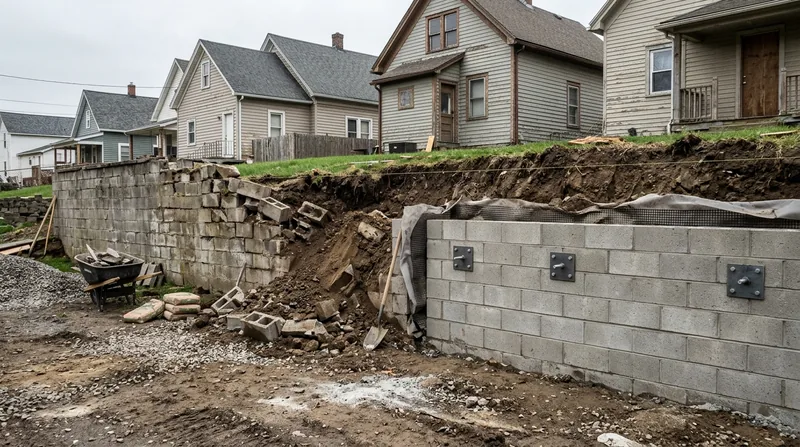




Leaning & Collapsed Wall Repair in Buffalo demands immediate attention. Buffalo's lake-plain clay, deep frost cycles, and relentless freeze-thaw action push retaining walls out of plumb every winter. Walls that tilt inward, bulge outward, or fail entirely under the weight of saturated clay and ice lenses are common across the city, from the Victorian neighborhoods of Allentown and Elmwood Village to the post-war subdivisions of Amherst and Cheektowaga. When a wall leans or collapses, the soil behind it moves downslope, threatening your foundation, driveway, or yard. Buffalo Retaining Wall responds with tieback anchors, drainage correction, and partial or full reconstruction to stop the failure and restore stability. We serve Buffalo, Tonawanda, Kenmore, West Seneca, and surrounding towns across Western New York.
Why Leaning and Collapsed Walls Fail in Buffalo: The Clay and Frost Problem
Buffalo sits on thick lake-plain clay and silt, the legacy of glacial Lake Warren. This clay holds water like a sponge. When heavy rain, spring snowmelt, or lake-effect precipitation saturates the soil behind your wall, hydrostatic pressure builds. Simultaneously, winter frost penetrates the clay, forming ice lenses that expand and push the wall forward. The combination of water load and frost heave is relentless. By March or April, a wall that stood plumb in October is visibly leaning. Block walls, poured concrete, and especially tired landscape timber and railroad tie walls from the 1970s and 1980s cannot resist this force without proper drainage and reinforcement.
- Hydrostatic pressure from clay saturation pushes the wall outward and down.
- Frost heave in deep Buffalo winters lifts and tilts the wall base, breaking the bond.
- Inadequate or failed drainage channels water behind the wall instead of away from it.
- Root systems from mature trees add surcharge weight and crack the wall structure.
- Aging timber and railroad tie walls lose structural integrity after 30 to 40 years of exposure.
Any of these conditions signals that repair or replacement is urgent. Delaying only spreads the failure and raises the cost.
Key info: Buffalo experiences average annual snowfall of 95 inches and lake-effect events that dump 2 to 3 feet in 24 hours. The December 2022 blizzard buried the region and accelerated wall failures across Cheektowaga, West Seneca, and North Buffalo. Walls that survived the 2014 Snowvember often fail the following spring when melt saturates the clay.
For detailed guidance on why walls fail and what to watch for, see our Retaining Wall Repair page.
How We Repair Leaning and Collapsed Walls in Buffalo: Our Step-by-Step Process
We begin every job with a site inspection to assess the degree of lean, the soil conditions, and whether the wall can be anchored and drained in place or must be rebuilt. In Buffalo's clay, we often install tieback anchors (also called soil anchors or dead-man anchors) that extend into stable soil behind the wall and pull it back to plumb. We also excavate and install new drainage systems, perforated pipe, and filter fabric to redirect water away from the wall face. If the wall is too far gone, we remove it entirely and rebuild with proper footing depth, drainage, and compaction.
- We excavate around the wall to expose the full height and assess the footing condition.
- We install tieback anchors into undisturbed soil at least 8 to 10 feet behind the wall face.
- We install or repair perforated drainage pipe with filter fabric at the wall base.
- We backfill with compacted drainage stone and native soil in proper lifts.
- We rebuild or reinforce the wall face with new block, poured concrete, or stone as required.
- We verify proper slope and grading to shed water away from the wall top.
The entire process protects your property and restores the wall to code compliance.
Example: A homeowner in Kenmore noticed her block retaining wall leaning 3 inches over the summer. We installed four tieback anchors, excavated and replaced the failed drainage system, and repointed the block. The wall is now plumb and stable. Total time on site, 4 days. Cost started at $4,200 and included all labor, materials, and grading. See our Retaining Wall Drainage page for more on drainage solutions.
Repair Methods and Materials for Leaning Walls in Buffalo
| Approach | Description | Best for |
|---|---|---|
| Tieback Anchors | Steel rods or cables anchored into stable soil 8 to 12 feet behind the wall and tensioned to pull the wall back to vertical. | Walls leaning 2 to 4 inches with sound structure; saves cost compared to full removal and rebuild. |
| Drainage and Backfill Repair | Excavate and remove failed or missing perforated pipe; install new pipe with filter fabric; backfill with compacted drainage stone and soil. | Walls failing from saturation; often paired with tieback anchors for maximum effect. |
| Partial Rebuild | Remove the upper portion of the wall (2 to 4 feet) and rebuild with new block, concrete, or stone on the original footing. | Walls with upper-section failure or deterioration; footing and lower wall remain sound. |
| Full Removal and Rebuild | Excavate and remove the entire wall; excavate footing below frost line (typically 48 inches in Buffalo); pour new footing and rebuild wall with proper drainage and compaction. | Collapsed walls, severe lean (6+ inches), or failed footing; ensures code compliance and long-term stability. |
| Geotextile and Reinforcement | Install geogrid or geotextile fabric within the backfill to increase shear strength and reduce lateral pressure on the wall. | Walls in high-clay areas or with steep slopes; often used in new construction but can be retrofitted during repair. |
Leaning and Collapsed Wall Repair Cost in Buffalo: What to Expect
Repair costs in Buffalo range from $2,500 for minor stabilization and drainage correction to $8,000 to $15,000 or more for full removal and rebuild of a tall or severely failed wall. The most common factors that determine your final price are the wall height, the degree of lean or collapse, soil conditions, access for equipment, and whether the wall sits on a slope or flat ground. A 20-foot block wall with 4 inches of lean, poor drainage, and soft clay typically costs $4,500 to $6,500 to anchor and repair. A collapsed 8-foot timber wall on level ground may run $3,200 to $4,800 for removal and rebuild. A severely failed 12-foot poured concrete wall on a hillside in Orchard Park or Hamburg may exceed $10,000 because of the footing depth, the slope stability work, and the equipment access required.
We always recommend getting two or three estimates before committing. Each contractor may propose a different method (tieback anchors versus partial rebuild, for example), and comparing approaches helps you understand the trade-offs. Call us at (716) 589-2564 for a free estimate with no obligation. We respond within 24 hours and can often visit the same day if the wall is actively collapsing or poses a safety risk. For a detailed pricing overview and examples by wall type and size, visit our Pricing page.
Leaning and Collapsed Wall Repair Near Me: What to Look for When Hiring a Contractor in Buffalo
Hiring the right contractor is critical because a failed repair wastes money and leaves you with the same problem. Start by verifying that the contractor is fully insured in New York State. Ask for proof of liability insurance (minimum $1 million) and workers compensation. Check references from recent jobs in Buffalo or nearby towns like Tonawanda, Kenmore, or West Seneca. A good contractor will provide at least three references and encourage you to call them. Ask references specifically about drainage work and whether the wall has remained stable through at least one full freeze-thaw cycle since repair.
Second, understand the permitting requirements for your wall. Many Buffalo jurisdictions require a permit for walls above 4 feet or when the wall supports a surcharge such as a driveway or structure. Engineered drawings may be required for tall walls or tiered systems. Always defer to your local building department to confirm the threshold. A contractor who brushes off permitting is a red flag. Third, if your wall is in an HOA community or a historic district like Allentown or Elmwood Village, check whether the HOA or historic preservation board requires approval before work begins. Some materials or heights may be restricted. Finally, get the repair scope in writing: what work will be done, what materials will be used, the timeline, and the total cost. Avoid verbal estimates and handshake deals.
Buffalo Retaining Wall is fully insured. We handle all permitting and coordinate with your local building department. We provide a free, no-obligation estimate and detailed written scope before we start. Call us at (716) 589-2564 or visit our Contact page to request an estimate today.
Leaning & Collapsed Wall Repair in Buffalo: Pricing Guide
| Service | Price | Details |
|---|---|---|
| Tieback anchors and drainage repair | Starting at $2,500 | Includes excavation, anchor installation, new perforated pipe, and compacted backfill for walls leaning under 4 inches |
| Partial wall rebuild (4 to 6 feet height) | Starting at $4,200 | Includes removal of upper section, new footing preparation, block or concrete rebuild, and drainage system installation |
| Full wall removal and rebuild (6 to 10 feet) | Starting at $6,800 | Includes complete excavation below frost line, new footing pour, full wall rebuild with proper compaction and drainage |
| Large-scale or complex repair (tall walls, steep slopes, multiple tiers) | On estimate | Engineered drawings, extensive excavation, reinforcement, or geogrid installation require on-site assessment for accurate pricing |
| Travel and site visit | Included | No travel fee or mileage charge within Buffalo and surrounding towns; free estimate response within 24 hours |
Indicative pricing, the exact cost depends on square footage, finish, and site access. Free personalized estimate within 24h at (716) 589-2564.


