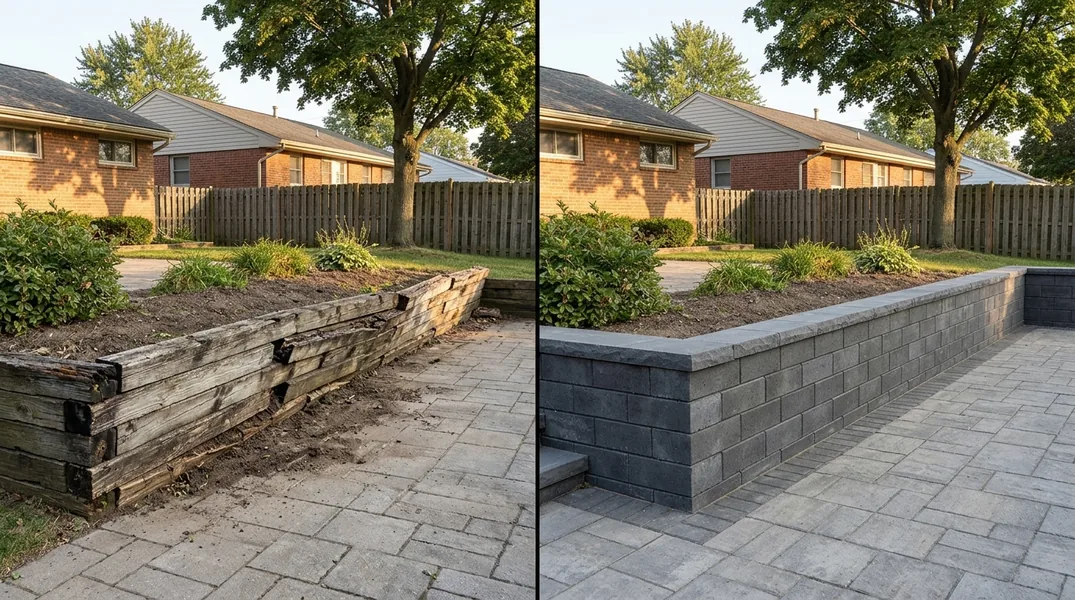
Why the Buffalo Spring Thaw Is the Most Dangerous Season for Retaining Walls
After a long Western New York winter, the spring thaw feels like a welcome relief. But for homeowners with retaining walls, those weeks of melting snow and refreezing nights are the most stressful time of year. The ground is saturated, the frost is leaving the soil, and millions of gallons of meltwater are looking for somewhere to go. If your wall was not built with proper drainage, that water will find its way into the backfill and begin pushing against the structure with enormous force.
This is the season when we get the most emergency calls at Buffalo. Walls that looked fine in October suddenly show bulging, leaning, or cracking by late March. The culprit is almost always water, not the blocks or the concrete itself. Understanding how drainage works, and what happens when it fails, is the first step toward protecting your property and avoiding a costly collapse.
How Hydrostatic Pressure Builds Up Behind a Wall
When soil becomes saturated, water fills the voids between particles. That water creates what engineers call hydrostatic pressure, which pushes outward in all directions. Behind a retaining wall, this pressure has nowhere to go except against the back of the wall. A cubic foot of saturated soil can weigh far more than dry soil, and the force multiplies quickly with depth. Even a modest four-foot wall can face thousands of pounds of lateral pressure after a wet spring.
Most retaining wall failures we diagnose in Amherst and across the region trace back to this exact problem. The wall was designed to hold back soil, but it was never designed to hold back a lake. Without a path for water to escape, hydrostatic pressure retaining wall failures become inevitable. The wall tilts forward, mortar joints crack, and in severe cases the entire structure can rotate or slide. If you notice any of these warning signs, it is worth scheduling a Retaining Wall Repair inspection before the damage worsens.
The Role of a Retaining Wall French Drain
The most effective defense against hydrostatic pressure is a retaining wall french drain. This system typically consists of perforated pipe wrapped in filter fabric and surrounded by washed gravel, installed at the base of the wall behind the backfill. As groundwater collects, it enters the pipe and is channeled away from the wall to a safe discharge point, such as a storm drain or a downhill grade. When designed and installed correctly, a french drain relieves nearly all of the water pressure that would otherwise push against the structure.
Unfortunately, many older walls in Williamsville were built without any drainage at all, or with a system that has long since clogged with sediment. We often find crushed corrugated pipe, fabric that has been breached by roots, or gravel that has filled with fines over the decades. In these cases, retrofitting a proper retaining wall drainage system is often the difference between a wall that lasts another thirty years and one that fails within a few seasons. During a Retaining Wall Replacement, we always build drainage into the new structure from the ground up.
Warning Signs of Drainage Failure You Should Not Ignore
Drainage problems rarely appear overnight. They usually give homeowners plenty of warning, but those warnings are easy to dismiss as cosmetic. Look for soil or mulch that has settled in a depression behind the top of the wall, which often indicates that backfill is washing into the drainage system. Water stains, efflorescence (a white powdery deposit), or dark damp patches on the face of the wall are also red flags. If you see water seeping from the wall itself after a rain, the drainage is already overwhelmed.
Structural symptoms are even more serious. A wall that leans outward, has horizontal cracks, or shows separation between blocks needs attention immediately. In Clarence, we frequently see timber walls that have rotted from the inside out because water was trapped behind them for years. If you are unsure whether your wall is safe, a professional evaluation is the best way to avoid a sudden collapse that could damage your home, driveway, or landscaping.
Retaining Wall Installation Near Me: Getting Drainage Right the First Time
If your wall is showing signs of failure, or if you are planning a new wall this spring, the most important decision you will make is who builds it. Proper drainage is not an optional add-on; it is a core part of the structural design. A qualified contractor will calculate the water load, specify the right pipe and gravel, and ensure the discharge point actually works with your property's grade. Skipping these steps to save a few hundred dollars almost always leads to thousands in repairs later.
At Buffalo Retaining Wall, we specialize in Retaining Wall Installation with engineered drainage built in from day one. We also install Concrete Retaining Walls that are especially resistant to freeze-thaw cycles and hydrostatic pressure. If you would like to understand what a proper drainage system costs, our pricing page outlines typical project ranges. The best next step is to request a free estimate so we can inspect your wall and recommend the right solution for your property.
Protect Your Wall Before the Next Freeze
Spring thaw is followed by summer storms, and then the cycle begins again. A retaining wall that survives one wet season without drainage may not survive the next. The good news is that drainage failures are preventable, and even walls that are already showing distress can often be stabilized with targeted repairs and a retrofit drainage system. The key is to act before the damage becomes structural.
If you live in or around Buffalo and your wall is showing any of the warning signs we discussed, do not wait for the next heavy rain. Call Buffalo Retaining Wall at (716) 589-2564 to schedule an inspection. We will evaluate the drainage, explain your options honestly, and help you protect your investment before the next thaw catches you off guard.
Looking for a professional retaining wall contractor in Buffalo? Buffalo Retaining Wall responds fast for all your retaining wall needs.
Get a Free QuoteOur services: Retaining Wall Installation · Retaining Wall Repair · Retaining Wall Replacement