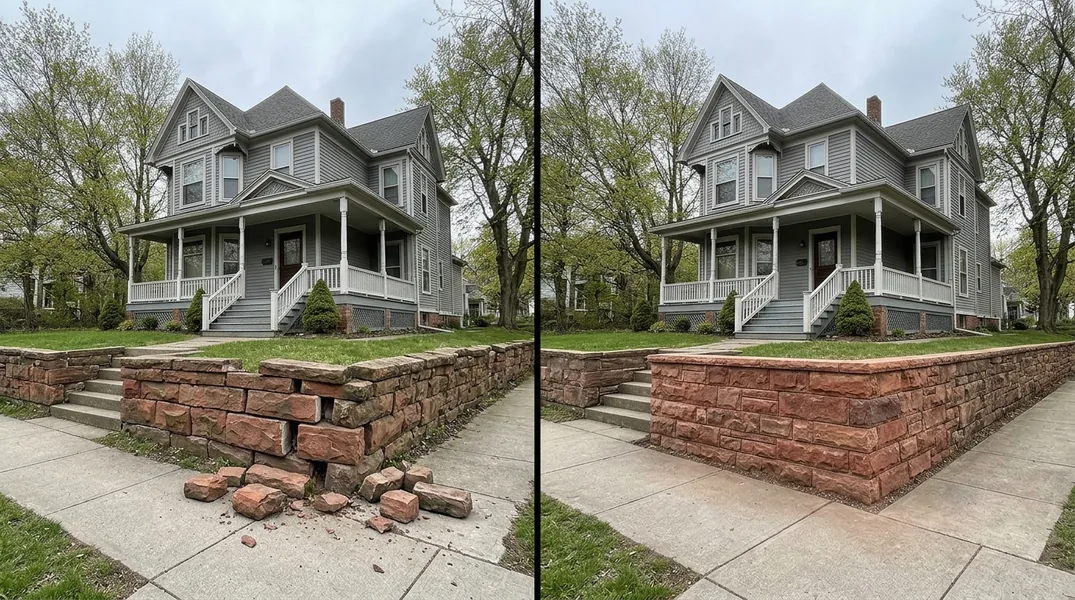
Why Frost Heaves Hit Buffalo Retaining Walls So Hard
If you live in Buffalo, you already know what a Western New York winter can do to pavement, fences, and foundations. Retaining walls are especially vulnerable because they hold back soil that expands when it freezes. Water trapped behind the wall saturates the backfill, then expands as temperatures drop, pushing the structure forward and upward. This is frost heave, and it is the single most common reason homeowners call us about a leaning retaining wall repair.
The problem is not just the cold. Buffalo's freeze-thaw cycles repeat dozens of times each winter, so the wall gets pushed, relaxes, and gets pushed again. Over several seasons, even a well-built wall can develop cracks, bulges, or a noticeable tilt. Homes in Amherst and Clarence face the same conditions, especially where clay-heavy soil holds moisture against the wall. Understanding why the damage happened is the first step toward deciding whether you need a fix or a full rebuild.
Signs You Need Leaning Retaining Wall Repair (And When It Is Urgent)
Not every crack means your wall is failing. Hairline cracks in the mortar or surface are often cosmetic, especially on older masonry walls. But some symptoms point to structural trouble that should be addressed before the next freeze. A wall that leans more than a few inches, has a visible bulge, or shows horizontal cracks running along the blocks is telling you the pressure behind it has overwhelmed its design. Stair-step cracks in block walls and soil seeping through joints are also red flags. If you see any of these, it is worth getting a professional assessment quickly.
Timing matters because a small problem becomes expensive fast. A wall that is only slightly out of plumb can sometimes be stabilized with proper drainage and targeted Retaining Wall Repair. Once the wall has moved significantly, though, patching the face does nothing to fix the cause. Homeowners in Williamsville often ask us whether a crack can simply be filled. The honest answer is that crack repair only works when the wall is otherwise stable and the water problem is solved. Otherwise, you are buying time, not a solution.
Repair or Replace? How to Make the Call
The decision usually comes down to three factors: how far the wall has moved, how old it is, and what it is holding back. A short garden wall that has shifted an inch or two may be a good candidate for repair, especially if the original construction was sound and the drainage can be corrected. A taller wall holding up a driveway, patio, or significant slope is a different story. When a structural wall leans, the cost to straighten and reinforce it often approaches the cost of a new wall, and the repaired wall may still be compromised.
Age matters too. Many Buffalo-area walls were built decades ago with materials and drainage methods that do not meet today's standards. If your wall is showing widespread deterioration, patching one section may just move the problem down the line. In those cases, Retaining Wall Replacement is usually the more economical choice over the long run. A new wall can be engineered for local soil and frost conditions, with proper drainage that prevents the same failure from happening again. If you are unsure which category your wall falls into, a free estimate is the fastest way to get a clear answer.
What Proper Retaining Wall Repair Looks Like in Western New York
Real repair is about fixing the cause, not hiding the symptom. For frost-damaged walls, that means addressing water management first. Weep holes, gravel backfill, and drainage pipe relieve the hydrostatic pressure that pushes walls forward. Depending on the wall type, repair may involve rebuilding the failed section, resetting blocks, or reinforcing the structure with anchors or geogrid. For concrete walls, Concrete Retaining Walls can sometimes be stabilized with crack injection and drainage improvements, but only when the wall is still structurally sound.
What you should avoid is the quick cosmetic fix. Filling a crack without relieving the pressure behind it usually leads to the crack reopening within a season or two. A reputable contractor will inspect the wall, check the drainage, and explain what is actually happening before recommending a fix. That inspection should include looking at the soil, the slope above the wall, and how water moves through your yard during heavy rain and spring thaw. If a contractor offers to patch and paint without addressing drainage, keep looking.
Retaining Wall Replacement Near Me: When a Rebuild Is the Smarter Investment
Sometimes the best repair is a replacement. If your wall has failed in multiple places, leans significantly, or was built without proper drainage, a rebuild gives you a structure designed for Buffalo's freeze-thaw cycles from day one. Modern Retaining Wall Installation includes compacted base material, geogrid reinforcement where needed, and a drainage system that moves water away from the wall. That combination is what prevents frost heave from doing the same damage again.
Replacement also lets you choose materials that suit your property and budget. Block, poured concrete, and natural stone all perform differently, and the right choice depends on wall height, load, and appearance. If you are searching for retaining wall replacement near me in the Buffalo area, look for a contractor who explains the engineering behind the wall, not just the price per square foot. A wall that is built correctly the first time costs less than fixing a failed one twice.
Retaining Wall Repair Cost in Buffalo: What to Budget
Homeowners ask about pricing early, and that is fair. Retaining wall repair costs vary widely based on wall height, length, material, and how much of the wall has failed. A small stabilization or drainage correction is far less expensive than rebuilding a section of a tall structural wall. Replacement is priced by square footage of wall face, plus excavation, backfill, and drainage. Because every yard is different, any honest contractor will want to see the wall before quoting a number.
The most useful thing you can do is get a written estimate that separates repair options from replacement options, so you can compare them directly. Ask what is included: drainage, excavation, disposal, permits if required, and a warranty. A low quote that skips drainage is not a bargain, because it sets up the same failure again. To get a clear picture for your property, call Buffalo Retaining Wall at (716) 589-2564 or request a free estimate. We will tell you honestly whether repair or replacement makes more sense for your wall.
Looking for a professional retaining wall contractor in Buffalo? Buffalo Retaining Wall responds fast for all your retaining wall needs.
Get a Free QuoteOur services: Retaining Wall Installation · Retaining Wall Repair · Retaining Wall Replacement